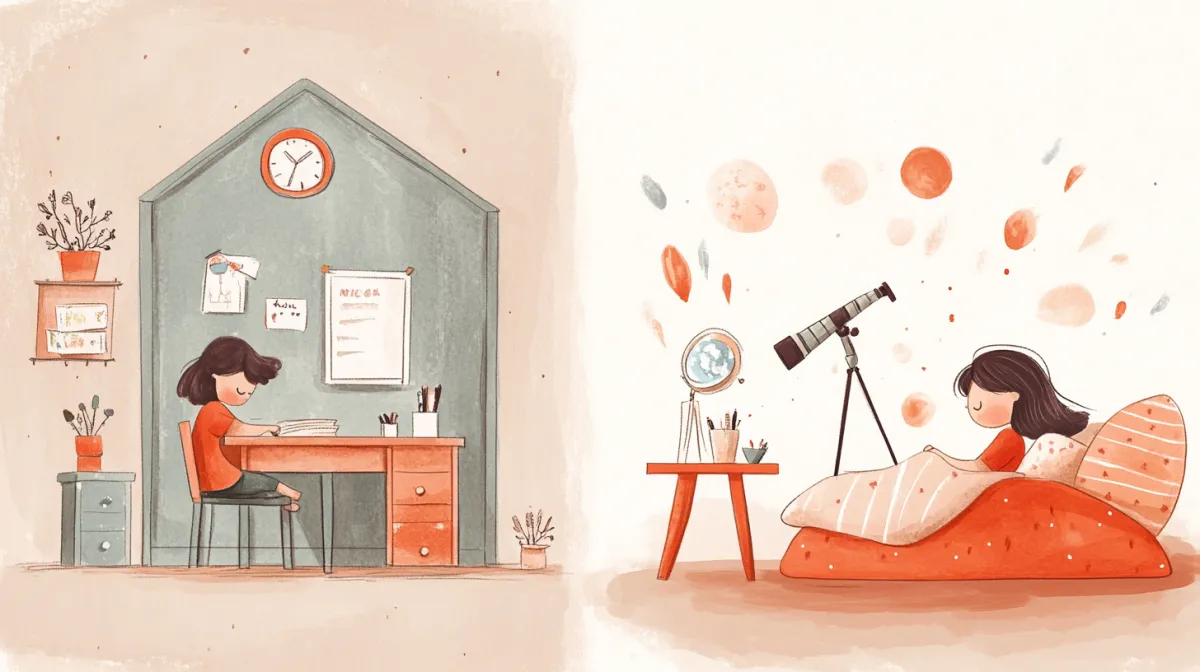
You Didn't Leave School to Build a Smaller, Sadder One in Your Dining Room
Your Homeschool Doesn't Need to Look Like a Classroom
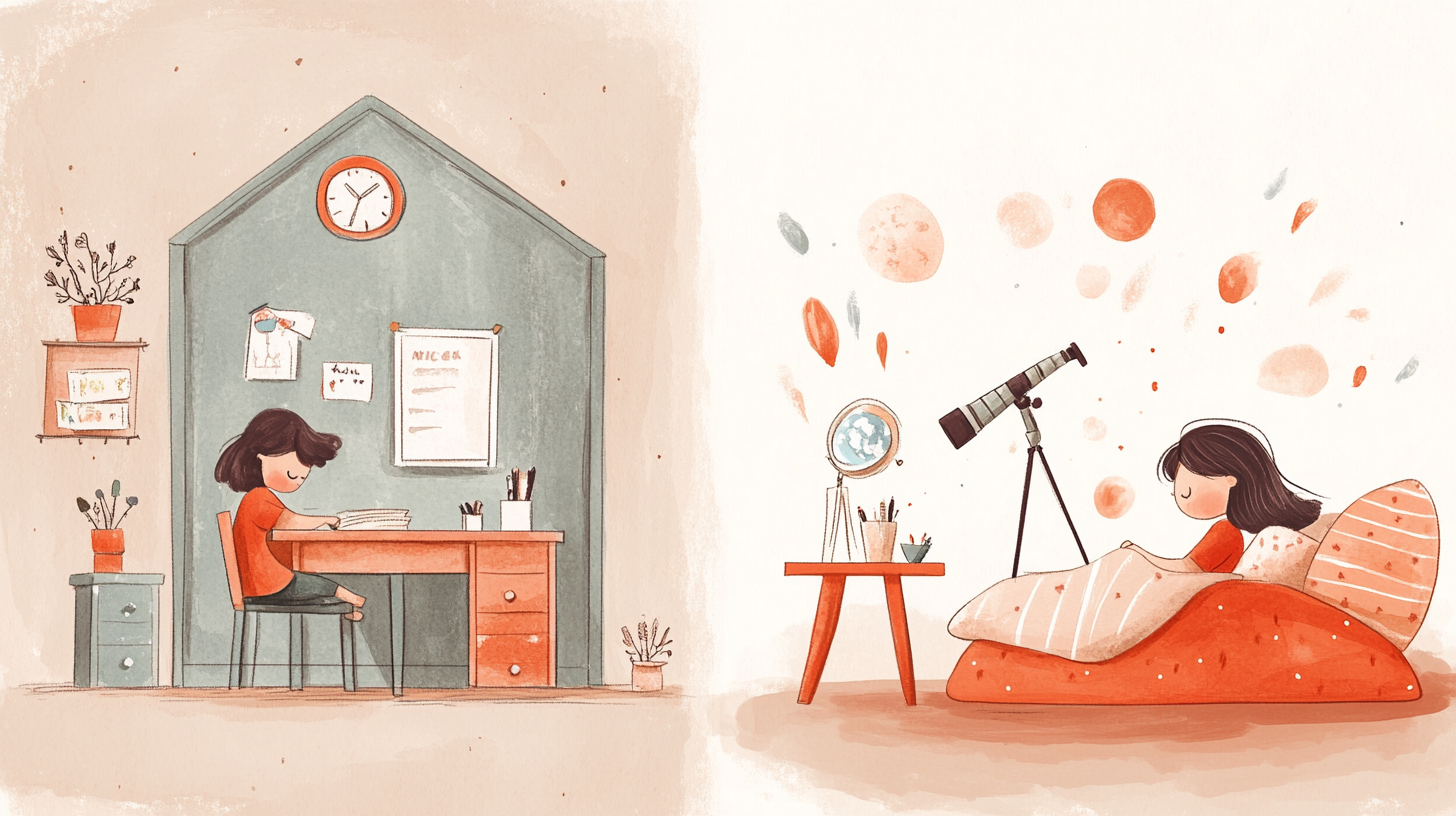
Tiny desks. Bulletin boards. A classroom flag. You spent $300 recreating a school in your spare bedroom because that's the only model you know. But the whole point was to break the model.
I see the photos on Instagram and my heart breaks a little.
Brand new homeschool room. Little desks in a row. A whiteboard mounted on the wall. An American flag in the corner. Alphabet border on the bulletin board. Color-coded bins. A bell on the teacher's — sorry, mom's — desk.
It's beautiful. It's Pinterest-worthy. And it's a trap.
Because what that room says, quietly but clearly, is: We left school, but school is still the blueprint. We don't know what else learning can look like, so we're going to recreate the only model we've ever seen, just with fewer kids and better snacks.
I get it. I did it too. My first year, I had a schoolroom with a million manipulatives, a globe, and a calendar wall. Every morning at 8:15, we'd "start school." I'd stand at the board like I was being observed by a principal who did not exist.
By November, my kids hated it. And honestly? So did I.
Why We Default to the Classroom
It's conditioning.
You spent roughly 15,000 hours in classrooms between kindergarten and your high school graduation. That's more time than you've spent doing almost anything else in your life. Of course that's your template. When someone says "learning," your brain conjures rows of desks, a teacher at the front, textbooks, worksheets, and a clock on the wall counting down to the bell.
But here's the thing: the classroom was designed for a specific problem that you do not have. The problem was: one adult needs to manage and instruct thirty children of the same age for six hours. Every feature of the traditional classroom — the desks, the schedule, the raised hand, the "quiet voice," the hall pass — exists to solve that problem.
You have two kids. Or five. Or one. You are in your own home. You do not need a hall pass.
What Learning Actually Looks Like
Learning looks like your kid lying on the floor reading a book about volcanoes because she just decided volcanoes are the most important thing in the universe.
Learning looks like your twelve-year-old helping you cook dinner and accidentally doing fractions when you ask him to double the recipe.
Learning looks like a nature walk where your six-year-old spends forty-five minutes watching ants carry a dead beetle, which turns into a two-day rabbit hole about insect colonies, which turns into a conversation about division of labor, which turns into a discussion about your family and how everyone has jobs that contribute to the whole.
None of that requires a desk.
Research backs this up. A 2015 study from the University of Salford (the HEAD Project, or "Clever Classrooms" report) found that classroom design — things like lighting, temperature, air quality, and spatial flexibility — accounted for a 16% variation in student learning progress over a year. The key word is flexibility. Rigid, traditional setups performed worse than spaces that allowed movement, varied seating, and natural light.
You have all of that. Your living room has a couch, a window, and a carpet. Your backyard has sunlight and dirt. Your kitchen has measuring cups and a stove. These are better learning environments than a repurposed spare bedroom with a poster of the multiplication table.
The Schedule Trap
The classroom mimicry doesn't stop at furniture. It extends to time.
"We do math from 9:00 to 9:45, then reading from 9:45 to 10:30, then..."
Why? Because that's how schools do it? Schools do it that way because they have to rotate 600 kids through shared spaces and specialists on a fixed schedule. You don't have a shared gym. You don't have a lunch lady. You have a kitchen and a willingness to be flexible.
Here's a radical thought: you don't have to do every subject every day. Your child's brain doesn't develop on a 45-minute rotation. Some days, you do three hours of history because your kid is fascinated by ancient Egypt and you'd be crazy to interrupt that flow state for a spelling test. Some days, you do math and read-aloud and call it done by lunch. Some days, you do life skills — laundry, meal planning, budgeting, oil changes — and that is the education.
The planes of development tell us that children go through seasons of intense interest and seasons of consolidation. A rigid daily schedule fights that reality. A flexible one honors it.
What to Actually Do
Ditch the dedicated schoolroom (unless it genuinely helps you organize materials — that's a different use case). Spread out. Do math on the porch. Read history on the couch. Do science in the kitchen or the yard.
Follow energy, not a clock. If everyone's focused and engaged, keep going. If everyone's glazed over after twenty minutes, stop. Take a break. Go outside. Come back when brains are ready.
Let the house be the classroom. Your home is already full of learning — cooking, cleaning, fixing, building, budgeting, gardening, sibling negotiation (conflict resolution is a life skill, and they're getting a master's degree in it daily).
Stop performing school. You don't need to prove to anyone — not your spouse, not your mother-in-law, not the internet — that "real learning" is happening by making it look like a classroom. Real learning doesn't look like anything in particular. It looks like your family, living and learning together, in whatever weird and wonderful way works for you this year.
The classroom is an industrial-age solution. You're not running an institution. You're raising humans. Act accordingly.
Sources
How Many Hours Do We Spend In School? — K-12 classroom hour estimates
Barrett, P. et al. (2015). "The impact of classroom design on pupils' learning." University of Salford HEAD Project — Classroom design and the 16% learning progress variation